Friday, 3 August 2012

Post Modernism, Week 2 Blog.


POST-MODERNISM


1. Define Post-Modernism using 8-10 bullet points that include short quotes.


- was a movement in architecture that rejected the modernist, avant garde, passion for the new. -James Morley.
- the project of rejecting tradition in favour of going "where no man has gone before" or better: to create forms for no other purpose than novelty- James Morley.
- this was an ironic brick-a-brack or collage approach to construction that combines several traditional styles into one structure.- Unknown.
-"Well according to Billy Corgan, Postmodernism is whatever the fuck you want it to be"- Unknown

-"The first dificultly in defining postmodernism, is that everyone. Everyone gets a crack at it." - Bruce Ellis Benson.
-A recent French philosopher defined Postmodernity as "incredulity towards all metanarratives. Thats a mouthful, but basically what it means, is a kind of sceptical attitude towards all claims of absolute truth. - Bruce Ellis Benson.
-Metanarratives; now the word he actually uses in French, really translates into English as "Big Stories". Now there are all kinds of big stories. One kind of big story might be 'human beings, by way of human reason, are capable of knowing... everything. - Bruce Ellis Benson.
- Postmodernism is a broad term used to describe movements in a wide range of disciplines, including art, philosophy, critical theory, and music.


2. Use a quote by Witcombe (2000) to define the Post-Modern artist.(page 24)
" The post modern artist is "reflexive" in that he/she is self aware and consciously involved in a process of thinking about him.herself and society in a deconstructive manner "demasking" pretensions, becoming aware of his/her cultural self in history, and accelerating the process of self-conciousness."


3. Use the table on pages 47 and 48 in your ALVC handbook to summarize the list of the features of Post-Modernity.


- Social & Cultural pluralism and disunity. Paying attention to surfaces and textures rather than Depth. Art as a process, or performance/production. Recycling culture authenticated by the audience to share identity with the artist. Irony, seriousness.


Use this summary to answer the next two questions.


4. Research Chinese artist Ai Weiwei's 'Han Dynasty Urn with Coca-Cola logo'(1994)
in order to say what features of the work could be considered Post-Modern.


Ai Weiwei is an amazing contemporary artist who is very active in a wide range of Art's, including instalation and sculpture, as well as being involved in Political and Cultural Criticism. He stands up for his rights, and has been beaten by the Police, arrested, and put in secret detention. ALL because of how his art affects the public. In Ai Weiwei's spare time, he literally designed the Beijing Olympic Stadium. 


In Ai's work titled "Han Dynasty Urn with Coca-Cola logo"(1994) he has taken what appears to be quite a historic, old looking vase, and put the Coca Cola Logo on to it. By doing this, is he putting today and the past into one clear format, just by looking at the pot you instantly know that the Coca Cola logo seems almost to modern for the style of the Vase. What he has done could be seen as quite disrespectful because this Urn appears to have alot of cultural meaning to it, it's not just a standard Urn - it has history behind it, it stands in representation to something or someone. So by putting a Coca Cola logo on it, it's almost like Ai was taking the piss out of the Urn, in the process. He's mixing two known things together- this historic Urn, and a Coca Cola logo. The Urn is so historically important, and the Coca Cola logo represents merely a fizzy drink, which the whole world recognises in seconds. Doing this, he has created a very Post-Modernist work.


The Photo of Ai dropping the Urn, shows that today, cultural importance is not as important as it used to be. By Ai dropping this Urn he is disregarding the object to the fullest extent, he's telling us that there aren't any people that would worry about what is occuring in this photo. And that is basically what Post Modernism is, adapting to cultural differences and making something out of it, but i think by dropping it he is telling the viewer that because of time, cultural aspects have been thrown out and forgotten about because thing's such as Coca Cola, for instance, have been designed for everyone, to bring cultures together. Also the way he drops the Urn, he shows no care in what is about to take place, and i think he is doing this to show China that traditional objects are no longer important to us because of Post Modernism, as in post modernism you are combining these cultural ideas into a sort of Melting Pot.


"If we look at history, nothing can give us more vivid a lesson than those pieces of evidence. You can talk about Greek or Roman civilization, or India or China or whatever. The image is still the most powerful. If we think about the United States, we think about Coca-Cola or McDonald's. And those things are so strong and so clear that we almost don't need another explanation. I suppose that's why art projects are needed - to reveal how history and reduced everything into such a nonsense image" - Ai Weiwei.


'Han Dynasty Urn with Coca-Cola logo'(1994), Ai Weiwei


Ai Weiwei dropping a Han Dynast Urn.


6. Research British artist Banksy's street art, and analyze the following two works by the artist
to discuss how each work can be defined at Post-Modern.(Use your list from question 3.)


Banksy is a very famous artist, who has been doing stencil graffiti art for many years, while hiding from the public to this day, nobody knows his name. But they do know that he makes work for meanings, to make change to the world. In his work "Flower Riot", he has put a human figure as a stencil, in a aggressive stance, similiar to one of a real person at a riot, tossing a molotov through the air. So you have this sense of anger and destruction, and what is to cause this "destruction"? Flowers. Banksy has replaced the "molotov" or a "brick" or whatever was in this person's hand, and replaced it with Flowers which shout "friendship" and "compassion". Its quite ironic really because why would one throw flowers at things to cause destruction? This is why Banksy, to this day, is still my favourite artist. Its not about money for him, it's about making a point. In terms of post-modernity, I do believe that there once apon a time no such thing as violence, and anger and destruction, and instead there was a constant energy of happiness that surrounded us. By doing this piece, Banksy may be saying that instead of breaking people's stuff, and destroying their belongings etc, why not give them Flowers? If you think about it, no matter what you throw, if you throw it in anger it does the same job. Throwing a book at the ground can involve the same anger as one that throw's a brick at a car. Maybe Banksy is just saying that if we are angry, pick something soft up and throw that. It seem's stupid, but it could easily be that simple. Post-Modernism involves the past and the present in one aspect, the flowers could represent that attitude that the public had years ago, verses the stenciled man throwing the flowers, which represents anger and destruction. 
'Flower Riot', Banksy


In Banksy's work "Los Angeles (2008), Banksy", he has taken a Prehistoric caveman, and shown this Caveman holding something that we can all recognise - a tray of Fast Food. Titling this "Los Angeles" shows that when Banksy thinks of Los Angeles, or pictures it in his mind, he see's fast food. This could be because of the large amount of obesity in America, or merely the fact that Fast Food is everywhere in America itself. The Previous artist, Ai Weiwei, did say that "If we look at history, nothing can give us more vivid a lesson than those pieces of evidence. You can talk about Greek or Roman civilization, or India or China or whatever. The image is still the most powerful. If we think about the United States, we think about Coca-Cola or McDonald's. And those things are so strong and so clear that we almost don't need another explanation. I suppose that's why art projects are needed - to reveal how history and reduced everything into such a nonsense image" - Ai Weiwei.

What Ai Weiwei was meaning was that when people get used to something for to long, we see it as being represented by an object or logo, for instance in Ai Weiwei's Dynasty Urn Work, people are more likely to recognise what the logo is, before they understand the background of the Urn itself. So maybe thats what Banksy is referring to, the fact that America is such a Fast Food Country, that eventually all it's really known for is Fast Food's, rather than the sight-seeing oppertunitys that they have available for tourists. He also could be using the stencil of the Fast Food to represent Fast Food in general, like it doesn't take much skill to look at this art and know what the Caveman is holding. The shapes in the Fast Food are very typical for a Mc Donalds order, as sad as it is i can easily tell that there is a Frozen Coke, Chips, and probably a Big Mac. It is alot easier to characterize which is what, unlike Ai Weiwei's art. Banksy is straight to the point with this Art by keeping it simple, to state that Fast Food is like second nature to us, we've known what it is since your first day you can remember, the Caveman represents history/age, so all in all he is saying that nowadays even cavemen know what Fast Food is, because it's everywhere, literally.

Saturday, 21 July 2012

Week One Blog, Symester #2.


1. What do you understand by the word 'claymation'?
From what i know, i believe "claymation" is basically what animation is - the process of making a movie seem as real as possible, while creating cartoon like characters out of clay. This is a very complex and difficult process because a single blink can go up to 10 frames long, which means that there is alot of adjusting of the clay models along with shading on the clothing to give it a realistic look. 

One example of claymation would be "Wallace & Grommit" (2005). This is actually one of my favourite movies to, and when you get in to it you realise how complicated it would be to make a whole movie out of clay; the settings, the backgrounds, the hats, the grass - its all clay. And that would take immense concentration and determination which is why I find "claymation" so interesting.

2. What is meant by the term 'surrealistic Garden of Eden'? and 'all that is natural goes awry'?

By looking at these pictures, i get this idea of an "exotic" sort of feeling because of the colours, such as the reds. Another thing that increases this exotic feelings is the strangely shaped tree's and habitation used in the works. Similiar to exotic areas such as the Amazon, for instance. The shades from the clay-formed-flowers and tree's create this sense of being surrounded, it reminds me of a recent movie called "Where The Wild Things Are" which is originally a childrens book.

Awry generally means to change courses, away from the appropriate, or askew. "all that is natural goes awry" could easily suggest that what Djurberg is making these objects for a purpose - this purpose could involve the environment itself, or she could be stating what is clear - she is creating what he said "all that is natural goes awry", by using claymation to create almost exagerated natural works.

3. What are the 'complexity of emotions' that Djurberg confronts us with?


When i look at Djurberg's work, i get this feeling of childhood again. The cartoon style, make-believe idea is so dramatic in her work, and then all of a sudden the story changes just like that and something will happen for no apparent reason, it just does. She creates this make-believe world of good going bad with her claymation, it begins by giving this childish, humourous feeling and then is followed by this almost gruesome, intense storyline that unfolds so quickly, and all of a sudden you are at the end considering watching it again because of the interesting ideas and art styles that flow throughout it. At one point your in a cheerful, happy mood because of what you are confronted with, but it is followed by this gruesome style of a kid program, it could simply put into an oppisitions catagory, because it targets both anger and pain, aswell as safety and security. 


4. How does Djurberg play with the ideas of children's stories, and innocence in some of her work?


The characters that she uses in her works are also seen in many children stories, in her works you will see for instance a blonde girl in comparison to a demon or a beast of some sort, which can be seen as relating to Beauty & the Beast. She uses basic storylines from tradition and well known children stories, and twists them into something more brutal and serious, with a essence of humour throughout it.

5. There is a current fascination by some designers with turning the innocent and sweet into something disturbing. Why do you think this has come about?


I think the reason for this is because its quite a risk to take something sweet and innocent  and make it disturbing. There are so many people in the world that stick to what they know in art, breaching the boundaries and giving something a twist can have major effects on the critics opinions. Changing something so cliche and known into something that it generally isn't, is major decision made by the artist. It's such a good idea, to do this, I mean why do something the same every time, when you could take something and put a completely different label on it, to produce something that completely wow's and shocks the audience. Sure, you may get insulted on the work, but it's worth the risk to learn different styles and such.


6. In your opinion, why do you think Djurberg's work is so interesting that it was chosen for the Venice Biennale?


In my opinion, her work has been chosen purely because it is such a different and interesting concept to work your art off of, there are some artists who do this concept but she definately pulls it off in an original way of thinking, its so straight forward and "if something happens, it does". Thats the best way i can describe her work, things don't have reasons for happening. They either happen or they don't.


7. Add some of your own personal comments on her work.


The thing i love about Djurberg's work is that its so unexpected, the plot of the stories tend to differ and have nothing to do with original children stories. There is a sort of irony about her work that makes me enjoy it so much, I mean to stand out from the crowd you must produce something extraordinary and different, and I think Djurberg has succeeded with that because after all, she was chosen for the Venice Beinnale which is pretty special. Her work is a concept in which few understand, and that few need to understand. Because with this style of work, you either understand it instantly, or don't understand it at all, its as simple as that and that is what makes Djurberg's work so fascinating.


"Experiment" (2009) Nathalie Djurberg, Venice Beinnale.


http://dictionary.reference.com/browse/awry 

Thursday, 24 May 2012

Week 8 Blog.


The artists of the late 1800's and early 1900's, in Europe, were influenced by the Industrial revolution.

1. What and when was the Industrial Revolution?


The Industrial revolution was a period in time in which major changes occured in industries such as agriculture, textile and metal manufacturing, transportation, the social structure and economic policies. It is named "revolution" however it isn't completely appropriate to name a certain time as a revolution, especially industrial-wise due to the fact that we are constantly improving manufacturing and such. The time it began is hard to say accurately, although 1760 is generally the time it began.

Both paintings featured on this blog, that are from the early 1900s were painted by Modernist painters from the group called 'Futurists'. The Futurists celebrated the machine, and objects in motion. Their primary objective was to depict movement, which they saw as symbolic of their commitment to the dynamic forward thrust of the 20th century.

2. Research both Modernist paintings in order to comment on the subject matter, form and style used to celebrate the machine and motion in each painting. Answer the question in 2 parts for each painting.

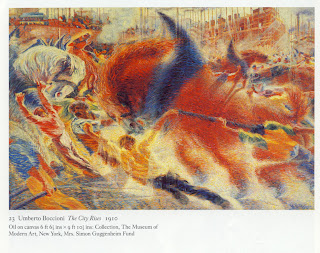
"Rises" By Boccioni (1910)-
the subject matter consists of horses, workers, and a construction site in the background. It appears to show the horses are jumping around as if they are startled or worried, and there are by the looks of it men trying to control the horses. When i first looked at this i was very confused, as everything is appeared to be moving around, or blurred out. I can definately see that there is a brown horse that is mainly centered in the painting, and appears to be knocking down the construction workers, or some of them anyway. The horse appears to be angry at the workers, and this may be because the industrial revolution brought apon the first car; maybe the horses are rebeling against the human in anger because they are in a way being replaced?


In , "Dynamism of a dog on a leash" by Balla (1912), the painting shows a lady walking her dog, the movement is shown clearly and easy to interpret because the legs of the dog, the dog itself, and the womans feet are blurred out. The dog itself isn't incredibly detailed, like you would expect to see in a painting of a dog, which shows that the dog is really moving. The dog looks like its trying to move faster than it can, its legs are moving alot faster than its body can  keep up with which is making it look humorous but enhances the idea of movement in this painting. This could easily relate to the Industrial Revolution; improvements in technology and manufacturing, it would generally be hard for the public to keep up with all these changes in everyday society. Im not sure why the lady is not in the photo, only her feet are shown, possibly to create a feeling of smallness, once again against the idea of vast improvements in technology.

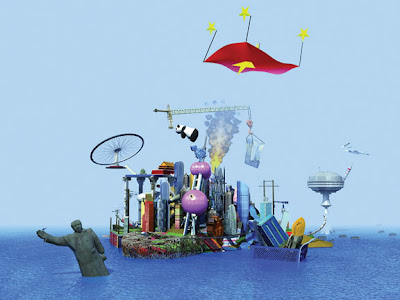
Cao Fei's RMB City (2007-9) refers to China's recent rapid industialisation and urbanization.
(www.artspace.org.nz/exhibitions/2009/cafeintopia.asp)

3. Research Cao Fei's RMB City (2007-9)  in order to comment on this work in more depth.
i.e describe the images that has she used in her digital collage that refer to China's present and history, and explain why has she used these images.

Named after Chinese money, it shows a perverse view of Beijing, a blend of capitalism, communism and socialism. And Like Beijing, it is always under construction, things such as candy-striped smoke stacks in the piece show continuous industrial production development, followed by ships moving out of the harbour. In Beijing also, everything is very clustered and very close together, almost like there are to many buildings in the city. Cao Fei has shown this by placing everything in the work very close together and centered, to make it seem that this one town of Beijing is almost like five towns in one. There are many cranes and futuristic looking buildings, in a video i watched on Youtube, the video shows many of the same things used in this piece; a clustered, busy and full-of-buildings city. When this was being designed, they firstly made a list of things that they wished to bring apon into existance. She then chose many factors that different cities in Beijing had in common, and fused them together in a way to create the RMB City.
4. RMB City is described as a utopia/dystopia. Comment on what these terms mean, and how they can be applied to the work.
A place, state, or condition that is ideally perfect in respect of politics, 
laws, customs, and conditions. 
Dystopia: A futuristic, imagined universe in which oppressive societal control and 
the illusion of a perfect society are maintained through corporate, bureaucratic, 
technological, moral, or totalitarian control.  Dystopias, through an exaggerated
worst-case scenario, make a criticism about a current trend, societal norm, or 
political system. 
  
Simply put, a Utopia is a place, condition or state that is perfect in every aspect of politics, laws, and conditions. This means that a Utopia, could also mean a perfect world. A world that had no issues or problems, there were no problems that could arise or had. Dystopia is a word used that describes a imagined, dream-like universe," in which oppressive societal control and the illusion of a perfect society are maintained through corporate, bureaucratic, technological, moral, or totalitarian control." 


RMB City is exactly that - a world that is perfect. it has everything everybody needs, its layout resembles a dream like world that would consist of no problems, no issues, and if problems and issues were to arise, they would be controlled in a neccessary manner. After all, Cao did have a list of things that were factors of a perfect world, and include them in her work, RMB City.


5. Although the Modernist paintings and the contemporary digital work have emerged from different contexts, there are also many similarities. Comment on the similarities that you can see in the work. Look at the moving digital image at vimeo.com/4272260, if you have not already researched it.


industrialism is still shown in rmb city. workers in painting would be "working" at the sites in this rmb city. shows change.


I couldnt find many similarities, although a few do stand out and the first is that in RMB City, signs of the industrial revolution are shown. For instance, when the Industrial Revolution began, there may have been cranes and large buildings, but they are nothing compared to what we have in this world today. the Industrial world is constantly changing and improving, and signs of that are definately shown in RMB City. Another similarity is that in "Rises" By Boccioni (1910), there are workers and a busy area/subject matter shown in the painting. in RMB City, there are buildings, and cranes, and a boat, and a plane and an archetectual building, none of these could have occured if it wasn't for the workers that built them. Its not a perfect similarity, but in ways it does have a connection. And last of all, it shows change. As i said, the Industrial revolution is constantly improving and changing. In "Rises" By Boccioni (1910), there are horses going wild and scaffolding in the background and workers running around, this shows a change in the society. In RMB City everything looks very futuristic, which could easily represent what Cao believes that will happen over time to the society.


http://www.youtube.com/watch?v=qi_jrNGa9RM
http://www.readwritethink.org/files/resources/lesson_images/lesson926/DefinitionCharacteristics.pdf


RMB City (2007-9)  Cao Fe


Dynamism of a dog on a Leash (1912) Giacomo Balla


"Rises" By Boccioni (1910)


Saturday, 5 May 2012

Landscape And The Sublime.


1. Define the Enlightenment, including its context (time and place).
The enlightenment was the new concept of ideas about life in general - man, society, etc. it challenged the original concepts of the world view, being dominated by christians. These ideas that were new to the world changed/brought change to many forms of art and such. It started around the 17th century, but we still in a way live in it as there is still a world view of thought based on the idea of the enlightment itself.

2. Define the concept of the Sublime.
The Sublime existed for two main reasons, as a "picturesque setting for some more important, human drama, and as a topography, or a quasi-scientific reconstruction of the land masses of a particular area". In order to be educated artistically, you would have to be able to walk before you could run. So if you wanted to paint, you would need to be able to draw first. The sublime was a concept that basically said that instead of being told to do by churches, you were told by government what was considered more important in terms of status and wealth, and what was not. It was an era in time in which a Hiearchy known as "The Salons" dictated which subjects were considered more important and most wealthy, for example history and religious subjects topped the list, while still life painting - something very challenging and difficult to produce  was left near the bottom of the list.


3. Explain how the concept of the Sublime came out of Enlightenment thought.
The Enlightenment developed a clearer world view of the arts and subjects taught. The concept of the Sublime was formed out of the Enlightenment by Higher-Ups making an order in which the subjects and arts were classified in a list of importance. The new world view of these subjects etc were placed in an order of importance and wealth, therefore leaving people in a position which basically told them that if you wanted to do well in life, you would have to study the subjects that were at the top of the list of importance, a new world-view of subjects and arts depicted this. All in all, the Sublime is a quality of greatness, whether it be i art, mathmatics, knowledge, etc.
4. Discuss the subject matter, and aesthetic (look) of Misrach's work to identify the Sublime in his work. Include some quotes from art critics and other writers who have written about his work
He has taken these photo's in a way that gives the viewer a feeling of being directly above the subject matter, as if we are looking at these people from a birds-eye view. I did some research and discovered that why he does this has something to do with the 9/11 tragity, he was "influenced" by images of people falling from the towers. So he may be trying to show us what the people in those towers saw the outside/ground like; looking out of the building and seeing paradise waiting for them at the bottom, as horrible as that sounds. 

 "In this body of work he uses a gorgeous, slowly shifting color palette gleaned from changes in depth and tide; abstract patterns of waves and rippling water, and beaches both empty and cluttered. Throughout the series, Misrach carefully balances the minutiae of human gesture against the massive scale of the sea. In some images, a lone figure floats in a liquid field of brilliant turquoise--or in others, lies beached and partially buried. The details in the images are frequently ambiguous. Are the figures relaxed or drained of life?"

In his works, in terms of sublime, he is editing his photos to produce as much brilliant colours and detail as possible to produce magnificent photography. Sublime, after all, is a quality of greatness; Misrach uses this to the furthest extent and it brings out the beauty in his photography. "As Misrach says, the work is "suffused with a sense of the sublime, but it also begins to expose our vulnerability and fragility as human beings.""

5. Add 2 new images of his work to your blog.
See bottom of this post.


6. Describe how does Misrach's photography makes you feel. How does it appeal to your imagination?
Misrach's photography feature very bright and happy colours, they give the feeling that there is no such thing as problems or stress or emotional issues. It gives me this idea of paradise, not having any worries or anything to consider an issue; just myself and the environment that surrounds me which would be anything but if i was in the subject matters situation. There is alot of space in these works which give this feeling of being alone in a big open area, which could be very peaceful, yet very spooky at the same time.

7. Identify some other artists or designers that work with ideas around the Sublime, from the Enlightenment era as well as contemporary artists.

Nicolas Poussin was a artist from the Enlightenment era.  His work featured such things as clarity, logic, and order, and favors line over color. His work serves as an alternative to the dominant "Baroque" style of the 17th century.  


8. Add a Sublime image of your choice to your blog, which can be Art or just a Sublime photograph.
9. Reference your sources (books and websites).

'Wanderer in the mists' (1818) Caspar David Friedrich


'Untitled #2" (2002) Richard Misrach

 'Untitled # 394-03' (2003) Richard Misrach


Richard Misrach Untitled 1132-04 [Flippers], 2004 
Battleground Point #1 (1999) Richard Misrach 


Tuesday, 20 March 2012


1. Mueck's sculpture is described as 'hyper-real'. Define the meaning of this term and explain how it is evident in his work.
"The simulation of something that never really existed" - Jean Baudrillard.
"The authentic fake" - Umberto Eco.
Hyper real is a term used to describe an exaggeration of something true or real. Blowing up, or increasing the size of something on photoshop, as an example, could be considered "hyper-real" as it is exaggerating the true size of an object or image. It also could only relate to objects that are man made, for example an actual person, or a animal. Taking an animal or a human, and increasing the size dramatically, or making it incredibly small, is what is considered hyper real.
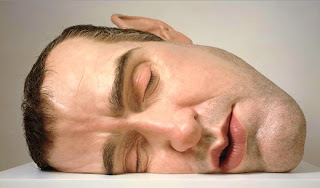
In Mueck's work, he does this by producing a human face titled "mask II" (2002), and also a baby titled "A Girl" (2006). But instead of creating an ordinary, life-sized sculpture of these objects, he takes the term "hyper-real" into action by producing these pieces and exaggerating the original sizes and making them alot larger. As you can see in the photo of the piece shown below titled "A Girl", there is a real person standing beside it, observing the piece. This person shows the viewer how exaggerated the size of the baby actually is, as the sculpture makes the person look incredibly tiny.  

2. Mueck says he is not interested in making life size sculpture. Find out why he is more interested in working with the scale of the figure which is not life size, and mention 2 works which use scale that is either larger or smaller than life. 

Mueck finds the human body fascinating, but prefers to work with hyper-real sized objects due to the fact that we see the human everyday, as an ordinary size. This size I am talking about is in general us. Our height, our width, our appearance. And because we know what we are, and how we look in terms of size and shape, Mueck see's that as the opportunity to produce something that is the complete oppisite and requires alot more time, patience and practice. Alot larger, whilst keeping the detail seen on a normal sized person; something that will shock the viewer and fascinate them at the same time.

3. Define Renaissance Humanism , and identify which aspects of Humanism can be seen in Mueck's work. Note that the contemporary definition of Humanism is much broader than the Renaissance definition.

All in all, Renaissance Humanism in a way gave birth to individualism - it was the beginning of when people stopped doing what the Churches and their religion told them to do, and started to search of things that ended up creating who they were in terms of morals, behavior, and truth's to live by. It is "a system of thought that considers human beings..." ( ALVC Resource Book, Page 55 ). The result of the Renaissance Humanism; scholars and such started to study the books of poetry, art,  and classical history in general. It basically turned people from being a sheep, to finding themselves and breaking the boundaries to discover who they really are, what they can believe in and what they don't.


4. Research and discuss one of Mueck's sculptures that you might find challenging or exciting to experience in an art gallery. Describe the work, upload an image of the work, and explain your personal response to the work. Comment on other student blogs to develop the discussion around the variety of our own personal and individual responses to art and design.

This is a sculpture of two old ladies, titled “Two Women”. It was done in 2005. This would be challenging for me due to the fact that it is significantly different to the other sculptures that were shown in his exhibition. The reason for this, is for many reasons, the first being the fact that it was the only sculpture in the whole exhibition to be clothed. Ron has clothed these women with coats, which give the suggestion that like these coats appear; that these women could and have lived a lifetime. The shoes they wear are very mature and sensible also, which further tells us that these women are more interested in the safety and sensibility of the purpose of clothing, rather than being a part of a trend or fashion sense. Another thing is the fact that with Ron's other works, there are something distinctive about them that give us the idea of them being larger or smaller than they should be (hyper - real). But with this, when you look at it, although it is smaller than two women should be, the women show something to the viewer/passes a thought through the viewers head that destroys the idea that they are smaller than usual. These women strike me as the type of old lady that would ask me to get off my skateboard as I skate past them, the type that would send nasty facial expressions to people generally being themselves. The reason for this is because they seem to be very “to themselves” sort of people. Very picky; the type of lady that would say “back in my day...” and rant on about how things were different back when she was in her childhood. What also interest’s me about this, is the facial expressions shown by the women. It puts the viewer in a position where he/she feels as if the sculpture is showing two women that are actually thinking about the viewer, rather than giving the viewer the opportunity to think about them.  It puts the viewer ( myself anyway ) in a position that gives us a feeling that we are doing something wrong, or in their eyes i am some sort of horrid being that should not exist. Obviously that is dramatically dramatic, but basically when i look at this sculpture, I get this feeling of insecurity. That all of a sudden instead of them being the subject matter, and the world is looking at them, it has turned around to me being the subject matter, and the world – including them – is watching me.
(I am not bothering about posting a link as i was only on google images)


Friday, 9 March 2012

Mercantilism

1. First define mercantilism, using material from your ALVC handbook, and explain how it has developed since the Renaissance.
According to the Comulbia Encyclopedia (2005); mercantilism is an economic system of the major trading nations during the 16th to 18th century. Its sort of like Merchanting, which is buying items, and selling them for profit etc. Now Mercantilism is no more, and instead Capitalism has taken its place.


2. Identify the ideas or concepts in Hall's work that relate to Mercantilism? 
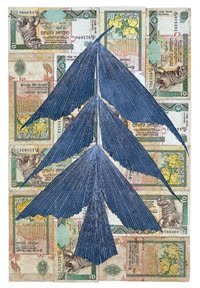
In Hall's work "Leaf Litter", she has gone to countries that have been affected by Mercantilism, and used there bank notes with her art. She has discovered what the main export (wether it be cocoa, coffee beans etc) was in that particular country, and drawn that export on the countries bank notes. She is trying to communicate the fact that the richest countries of the world, are now amongst the poorest due to people taking from each other and trading. Taking advantage of poor countries, so others can become wealthy of their exports.

3. For each work describe the shape, form and materials used, and also explain the ideas behind each example.
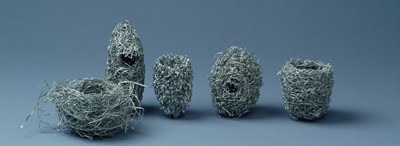
In Tender, she has shredded dollar notes, and created bird nests etc. I guess she is trying to portray the whole concept of people cutting down large amounts of forrest's for money, and bird nests will have obviously been destroyed to do so. 


In Leaf Litter, (as said in q.2) Hall has used many different currencies from countries that were the main exporters in that time, and connected them to create a panel, and then drawn the main item that was exported onto the currencies/bills. 


4. In your opinion do the materials communicate the ideas of the work? Please explain your answer. 
In my opinion i think that the way Hall potrays the ideas she is trying to communicate with us is very interesting. Obviously for me it was very complicated but once you see the main idea you start noticing other things. I think the concept of it all is very amazing and creative; using money to create things that have been destroyed originally to make money is a very cool concept. 


5. Fiona Hall's recent project The Kermadecs focuses on issues around the Pacific ocean. Research this project to summarize the importance of the area and upload an image to your blog for discussion. 


"The Kermadecs" is a area between New Zealand and Tonga, its an area  in the middle of the Pacific ocean, which is the holder of the largest volcanic arc in the world. the volcanic island's hold many undiscovered life forms of animals and such, the National Geographic Society has delcared it to be "one of the last pristine sites left in the ocean". The project was bases on nine artists visiting this location and helping protect it, and preserve it for further exploration.


http://en.wikipedia.org/wiki/Mercantilism
http://eyesing.typepad.com/eyesing/2008/05/leaf-littering.html
http://www.thekermadecs.org/fiona-hall